Choose a hinged (swing) wardrobe if you have room for the doors to open. It costs less, gives full access and is simpler to maintain. Choose a sliding wardrobe if the bedroom is tight, because it needs no swing space. For most Kerala homes with a reasonably sized master bedroom, hinged is the better default.
This is one of the most common questions we hear during home interior design consultations, and the honest answer depends on three things: how much clearance you have, what you can spend, and how much upkeep you will tolerate.
How Each Wardrobe Works
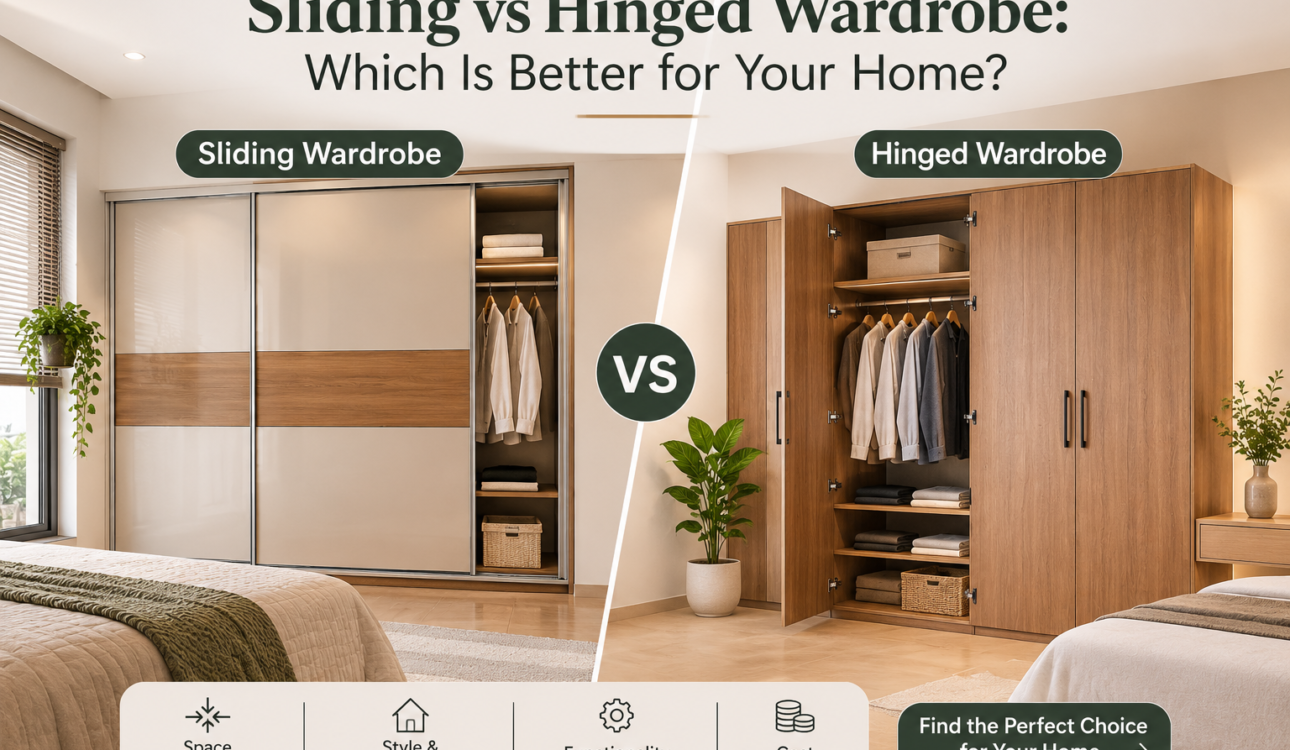
A hinged wardrobe has doors fixed on hinges that swing outward, like a cupboard. A sliding wardrobe has doors that glide along a track, one in front of the other. That one mechanical difference drives every trade-off below.
Sliding vs Hinged: Side-by-Side Comparison
| Factor | Hinged | Sliding |
|---|---|---|
| Space needed | Needs swing clearance in front | Needs no floor space to open |
| Cost | Generally cheaper | Generally pricier (tracks, fitting) |
| Access | Whole wardrobe opens at once | One section visible at a time |
| Maintenance | Simple; no tracks | Tracks need regular cleaning |
| Look | Traditional, many handle options | Sleek and modern |
| Mirrors | Full-length mirror fits on a door | Mirror panels raise the price |
| Best for | Larger bedrooms | Compact bedrooms, wide built-ins |
Which Is Cheaper?
Hinged wins on price. One 2026 cost guide puts sliding wardrobes at roughly 20–40% more per sq ft than openable ones, because of the track system, precise fitting and any glass or mirror panels. On a 56 sq ft master wardrobe, that gap is about ₹25,000–45,000. Treat these as indicative, since prices vary by city, board and hardware brand. For a wider view of budgeting, see our 2BHK interior design cost guide.
Which Needs Less Space?
Sliding. A hinged door needs clearance roughly equal to its width, typically 45–60 cm, so a wardrobe opposite the bed can leave the room cramped. If the walkway between bed and wardrobe is narrow, sliding stops you from bumping doors every morning. In a roomier bedroom, that advantage disappears, and you are paying extra for nothing.
The Kerala Factor: Humidity and Upkeep
Most generic guides skip this. Monsoon humidity and dust collect in sliding tracks, and a sticking track is the usual weak point of a sliding design. Hinged wardrobes have no tracks to clog, which makes them more forgiving in coastal and high-rainfall areas. For either type, the board matters more than the door style. BWP ply or HDHMR resists moisture far better than particle board, so choose them for outside walls. Soft-close hinges and branded tracks also last longer, though they add cost.
Hardware Matters More Than the Door Style
Hinges and tracks are the moving parts you touch every day, so they deserve attention. Per the same cost guide, a local soft-close hinge costs about ₹40–90 each, while branded hinges run ₹180–450. A branded sliding track can cost ₹2,500–6,000 per shutter. Moving a master wardrobe from local to branded hardware adds roughly ₹8,000–18,000. That is a small premium for something you will open thousands of times, so spend here before you spend on a fancy shutter finish. Laminate shutters look good and cost far less than acrylic or lacquered glass.
Plan the Inside Before the Doors
Door style gets the attention, but the interior decides whether the wardrobe works. Decide where hanging space, drawers, shelves and a loft go first. Sliding doors suit wide wardrobes with a loft above, while hinged doors let you add inside-door racks for belts and accessories. Share your daily routine with your designer, then pick the door.
When to Choose Which
- Choose hinged if your bedroom has at least a door-width of clear floor in front of the wardrobe.
- Choose hinged if you want full visibility of your clothes at once.
- Choose sliding if the room is compact or the wardrobe wall is very wide.
- Choose sliding if you want a sleek, minimal look with mirror or glass panels.
You can also mix them. A sliding wardrobe in a tight master bedroom and a hinged one in the spacious guest room is a sensible split that balances budget and space. Our home packages typically include soft-close wardrobes sized for each bedroom, which you can compare on our home interior packages page.
Common Mistakes to Avoid
- Choosing sliding doors for a roomy bedroom, then paying extra without needing the space.
- Ignoring the board quality and spending only on the door finish.
- Forgetting that sliding doors never open the full width.
- Planning the wardrobe after buying the bed. Our guide on hiring a designer before buying furniture explains why order matters.
Frequently Asked Questions
Is a sliding wardrobe better than a hinged one?
Only when space is tight. Sliding saves floor space but costs more and needs track upkeep. Hinged is the better value in most bedrooms.
Which wardrobe is cheaper, sliding or hinged?
Hinged. One cost guide estimates sliding at about 20–40% more per sq ft.
Which wardrobe lasts longer in humid weather?
Hinged wardrobes have no tracks to clog, so they usually need less maintenance. Whichever you pick, use moisture-resistant board.
Can I put a mirror on a hinged wardrobe?
Yes. A full-length mirror on a door often removes the need for a separate dressing table.
What clearance does a hinged wardrobe need?
About one door width, typically 45–60 cm, in front of the wardrobe. Measure before you decide.
Can I mix sliding and hinged wardrobes in one home?
Yes. Many homeowners use sliding in the compact master bedroom and hinged elsewhere. Our designers can advise on the right mix.
Not sure which suits your room? Send us your bedroom measurements and we will recommend a layout. See our home interior work in Kochi and Trivandrum, browse completed projects, or get a free quote today. Planning the whole home? Read our guides on TV unit trends and choosing a modular kitchen.