If you’ve spent even one monsoon in Kerala, you already know why plywood shutters swell, MDF edges bubble, and hinges start sagging within a couple of years. It’s the reason so many homeowners in Kochi, Trivandrum, and Kollam are switching to aluminium kitchen cabinets instead of fighting the humidity every June. But “aluminium kitchen” isn’t one product — it’s a category with at least four very different constructions, and picking the wrong one means you’ve just swapped a wood problem for an aluminium one. After specifying cabinets for Kerala kitchens across coastal and backwater homes, here’s the honest breakdown of which aluminium actually holds up, and which is mostly marketing.
Why Aluminium Even Enters the Conversation in Kerala Kitchens
Kerala’s cooking style is hard on cabinetry. Fish curry prep means wet fish and masala paste splashing onto shutter fronts. Tempering — that quick hit of mustard seeds and curry leaves in hot coconut oil — throws a fine film of grease onto everything nearby. Add near-90% humidity for four months of the year and termite pressure that’s simply higher than in drier states, and you understand why plywood carcasses, however well laminated, eventually delaminate at the joints. Aluminium doesn’t absorb moisture, doesn’t warp, and termites have no interest in it. That’s the entire case for switching — everything else is about which aluminium format delivers on that promise without looking like a hospital pantry.
The Four Aluminium Options, Ranked Honestly
1. Powder-Coated Aluminium Profile Shutters — the one to choose
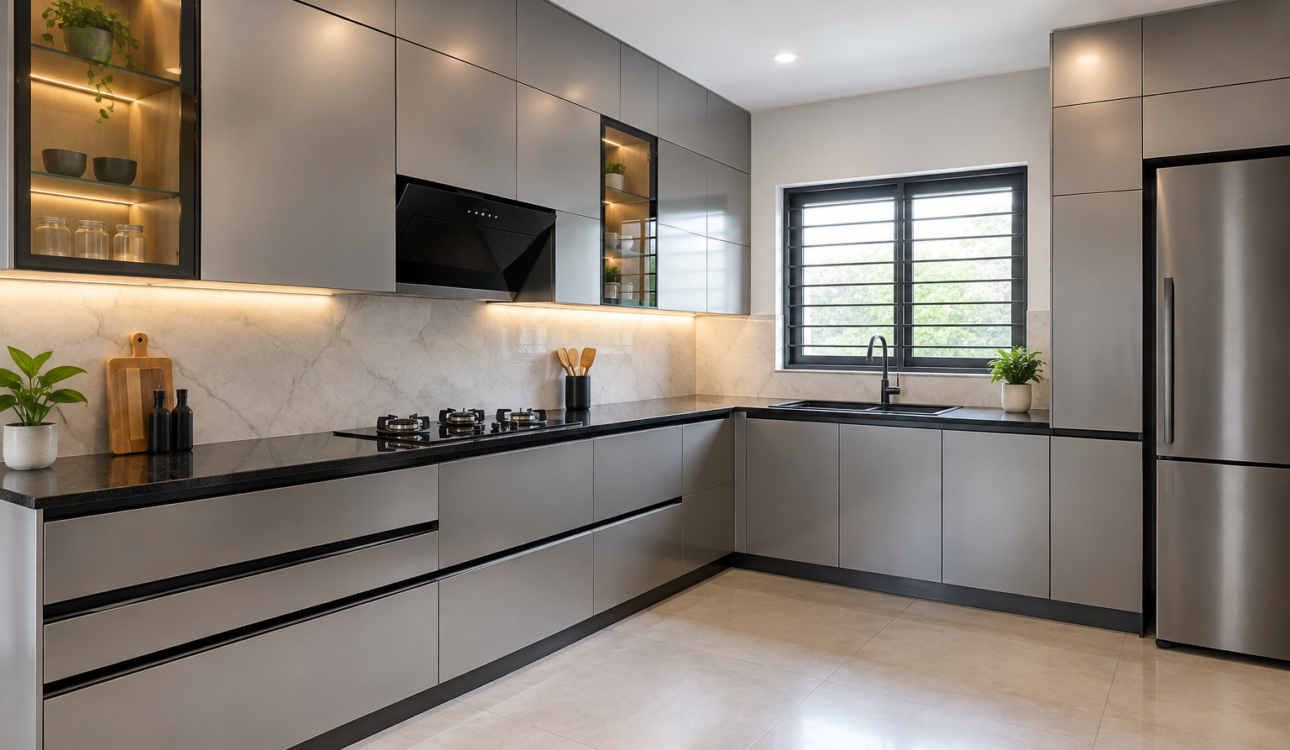
This is an extruded aluminium alloy frame (usually 6063-grade) that holds a glass, acrylic, or high-pressure laminate infill, finished with a baked powder coat rather than paint. It’s the standard now for kitchens across our modular kitchen design projects, and for good reason: the powder coat is UV-stable, doesn’t yellow near a window, and shrugs off the oil-and-water combination that ruins laminate edges within a couple of years. The profile frame also means no exposed MDF edge banding to peel off in humidity — which is the actual failure point in most “waterproof” kitchens that aren’t truly waterproof.
2. Anodized Aluminium
Anodizing forms a hard oxide layer on the aluminium surface rather than sitting a coating on top of it, so it’s genuinely more scratch-resistant than powder coating. The trade-off is a narrower colour and finish range — mostly metallic silver, bronze, and champagne tones — and it costs noticeably more. Worth it for a minimalist, all-metal kitchen aesthetic; overkill if you want matte pastel or wood-look shutters.
3. Aluminium Honeycomb Panel Shutters
A thin aluminium skin bonded over a honeycomb core, then faced with laminate or acrylic. Lightweight and rigid, and a common choice for tall wardrobe-style kitchen units where a solid profile shutter would be heavy on the hinges. The weak point is the bond line — if the adhesive is poor quality, the skin can start lifting at the edges after a few years of steam and heat near the hob.
4. Aluminium Composite Panel (ACP)
ACP is built for building facades and signage, not cabinetry. It’s thin, flexes under normal cabinet loads, and the core is usually polyethylene, which isn’t ideal directly behind a stove. Some budget vendors push it as a “modern aluminium kitchen” option because it’s cheap, but it’s the one genuinely worth avoiding for shutters — use it for decorative panelling elsewhere in the home if at all.
What “Best” Actually Depends On
For a typical Kerala kitchen — hob-adjacent shutters, sink base cabinets, tall units — powder-coated aluminium profile shutters win on the combination that matters: moisture immunity, termite immunity, colour flexibility, and a repair cost that doesn’t require replacing the whole panel if one shutter gets dented. Anodized aluminium is the upgrade if budget allows and you want a genuinely premium, scratch-proof metallic look. Honeycomb panels are fine for tall storage units where weight matters more than moisture exposure. ACP shouldn’t be anywhere near your cooking zone.
One detail vendors rarely explain upfront: ask for the aluminium gauge (thickness) and the alloy grade, not just the finish name. A 6063-T5 profile at 1.2mm-plus wall thickness will outlast a thinner, unspecified “aluminium” frame by a decade, even though both get sold under the same label. Our complete guide to modular kitchen design goes deeper into how cabinet material choices interact with layout and hardware, if you’re still deciding on the full kitchen spec.
Maintenance Reality Check
Powder-coated and anodized aluminium both wipe clean with a damp cloth — no special cleaners needed, and none of the swelling-at-the-seam issue that plywood shutters develop near the sink. The one thing to watch: harsh abrasive scrubbers can dull a powder-coated finish over years of aggressive cleaning, so a soft cloth is worth the habit. Beyond that, aluminium kitchens in our Kochi and Trivandrum projects are genuinely low-maintenance compared to anything wood-based.
Is Aluminium Worth the Cost Over Plywood or WPC?
Aluminium profile shutters typically run higher upfront than standard plywood-with-laminate shutters, but the comparison isn’t fair unless you price in five years of Kerala humidity. WPC (wood-polymer composite) is the middle-ground option — better moisture resistance than plain plywood, cheaper than aluminium — and a reasonable choice for low-splash zones like tall units away from the hob. For the wet zone directly around your sink and stove, aluminium’s total cost of ownership usually wins once you account for the plywood shutters you’d otherwise be replacing.
If you’re weighing this for a specific home, our design teams working across Kochi, Trivandrum, and Kollam can walk you through gauge, finish, and pricing for your specific layout during a site visit.
Frequently Asked Questions
Is aluminium better than plywood for kitchen cabinets in Kerala?
For zones exposed to moisture and steam — under the sink, around the hob — yes. Aluminium doesn’t swell or attract termites, both of which are real risks for plywood in Kerala’s climate. For dry storage units away from water and heat, good-quality marine plywood is still a reasonable, lower-cost option.
How much does an aluminium modular kitchen cost per square foot in Kerala?
Powder-coated aluminium profile shutters typically run in the range of ₹1,200 to ₹2,200 per square foot depending on finish and infill material (laminate versus acrylic versus glass), while anodized aluminium sits higher, often ₹1,800 to ₹2,800 per square foot. Actual pricing depends on the shutter design and hardware brand.
Does aluminium kitchen furniture rust in coastal areas like Kochi?
Properly powder-coated or anodized aluminium doesn’t rust the way steel does — the aluminium itself forms a stable oxide layer, and the coating adds a second barrier. Cheap, unfinished aluminium or poor-quality coating can pit over years near the coast, which is why the coating quality matters more than the metal itself.
Can aluminium kitchen cabinets be repaired if a shutter gets dented?
Minor dents in a profile frame are harder to pull out than a laminate shutter, but the advantage is that individual panels or infill pieces can usually be swapped without replacing the whole shutter, unlike a bonded honeycomb or ACP panel where damage often means full replacement.
What thickness of aluminium is recommended for kitchen shutters?
Look for profile wall thickness of at least 1.2mm in a 6063-grade alloy for structural shutter frames. Thinner gauges cut cost but flex more over time, especially on wider shutters or heavily used cabinet doors.
Is an aluminium kitchen a good option for a rental or budget home in Kerala?
It can be, but budget-tier ACP-based “aluminium” kitchens aren’t the same product as profile-based aluminium kitchens, despite similar marketing. If cost is the main constraint, WPC shutters usually offer better value than low-grade aluminium alternatives.