
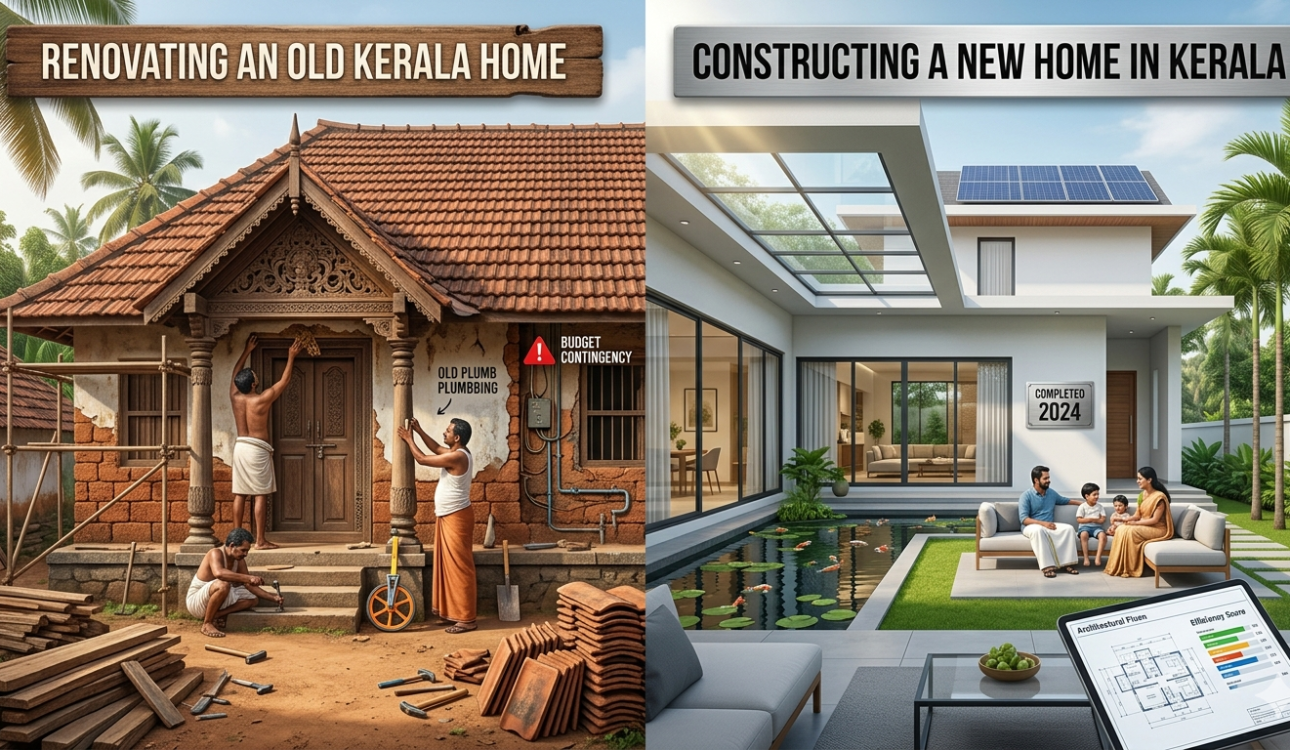
It is one of the most consequential decisions a Kerala homeowner will make: do you breathe new life into the ancestral home that holds your family’s memory, or do you tear down and build something entirely new? Whether you are an NRI returning to Trivandrum, a growing family in Kochi, or a retiree in Kollam looking to finally live in a home built on your terms — this question deserves a thorough, honest answer.
In 2026, both paths are more viable than ever — and more expensive than ever. This guide breaks down every key consideration so you can make the right decision for your specific situation, your budget, and your vision.
“The best home decision is never about trends — it is about understanding what your land, your budget, and your family actually need.”
The Core Question: What Are You Really Choosing Between?
Renovation means working within the existing structure of your home — preserving load-bearing walls, retaining the original floor plan’s logic, and updating finishes, systems, and spaces to modern standards. Construction means starting from a cleared plot with a blank architectural canvas. Both approaches, when executed well by experienced professionals — whether the best interior designers in Trivandrum or veteran structural engineers in Thrissur — can produce a stunning, fully modern home. The difference lies in what each path demands from you.
Side-by-Side Comparison
| RENOVATION | NEW CONSTRUCTION |
| ✔ Preserves emotional and cultural value of ancestral home | ✔ Complete design freedom — every room built for your lifestyle |
| ✔ Lower land and demolition costs | ✔ Modern structural compliance from day one |
| ✔ Faster timeline — 6 to 14 months typically | ✔ Better energy efficiency with new materials |
| ✔ Less bureaucratic approvals needed | ✔ Integrated smart home systems from the ground up |
| ✖ Hidden structural surprises drive up cost | ✖ Higher upfront cost — demolition, approvals, full build |
| ✖ Limited layout freedom — walls and beams constrain design | ✖ Longer timeline — 18 to 36 months for quality builds |
| ✖ Older electrical and plumbing may need full replacement | ✖ Loss of sentimental value and mature landscaping |
The Cost Reality in Kerala 2026
Cost is where most families make their final decision — and where the most surprises occur. In Kerala’s current construction market, material prices remain elevated from post-pandemic supply chain corrections, and skilled labour is in high demand, particularly in cities like Kochi. Here is a realistic breakdown of typical cost ranges:
| Item | Renovation | New Construction |
| Basic cost per sq. ft. | ₹1,200 – ₹2,000 | ₹2,200 – ₹3,500 |
| Premium finish per sq. ft. | ₹2,500 – ₹4,000 | ₹4,000 – ₹6,500 |
| Structural contingency | 15–30% extra risk | 5–10% typical buffer |
| Interior design (1,500 sq. ft.) | ₹8L – ₹18L | ₹12L – ₹30L+ |
| Project timeline | 6–14 months | 18–36 months |
One critical point: renovation budgets in Kerala are notoriously prone to cost overruns. Once walls are opened, it is common to discover rotted timber, outdated asbestos roofing, or undersized foundations that require significant remediation. Always build a 25–30% contingency into any renovation budget.
Structural Assessment: The First Step Before Any Decision
Before you commit to either path, commission a structural audit of your existing home. This is a non-negotiable step. A qualified civil engineer will assess foundation integrity, roof structure, beam and column conditions, moisture penetration levels, and the condition of existing plumbing and electrical. In coastal areas of Kerala — from Kollam northwards — saltwater corrosion of reinforcement steel is a serious issue in older homes that is impossible to detect without proper investigation.
Structural Audit Checklist
- Foundation depth and crack mapping — critical in laterite soil areas
- Check for steel reinforcement corrosion, especially in coastal districts
- Assess roof structure: traditional Mangalore tile roofs often hide rotted timber purlins
- Evaluate existing electrical load capacity against modern requirements
- Test for asbestos in older ceiling and roofing sheets — common pre-1990 builds
Design Possibilities: Where Each Path Shines
Design flexibility is a major differentiator. New construction allows your architect to optimise every aspect of spatial planning — ceiling heights, window placement for cross-ventilation, the position of wet areas, and the integration of a home theatre or gym. The best interior designers in Kochi working on new-build projects routinely deliver open-plan spaces, double-height living rooms, and seamless indoor-outdoor transitions that are simply not possible within an existing structure.
Renovation, however, has its own design rewards. A skilled designer can work with original features — polished red oxide floors, carved wooden beams, traditional arched doorways — and transform them into the focal points of a contemporary interior. Some of Kerala’s most celebrated residential projects in recent years have been thoughtful renovations where old and new exist in deliberate, beautiful tension. The best interior designers in Kollam have particularly distinguished themselves with this blended approach, integrating traditional Travancore architectural elements into highly modern interiors.
“A great renovation does not erase the past — it curates it, deciding what deserves to stay and how it can anchor the new.”
Regulatory and Approval Landscape in 2026
Kerala’s building regulations have tightened significantly in recent years, and 2026 brings updated coastal regulation zone rules and stricter green building norms for new construction above 3,000 sq. ft. New builds require full plan sanction from the local body — Panchayat, Municipality, or Corporation — along with environmental clearances in flood-prone or ecologically sensitive areas. Renovation projects, particularly those that do not change the external footprint, typically require simpler permissions and move faster through the system. This regulatory advantage can mean 6–9 months saved in project timeline for a renovation versus a new build.
2026 Approval Requirements at a Glance
- New construction: full building permit, structural drawings, CRZ clearance in coastal zones, rainwater harvesting plan mandatory
- Renovation (no footprint change): minor works permit sufficient in most Panchayat areas
- Renovation (adding floors or extending footprint): treated as new construction for approval purposes
- Solar installation: now mandatory for new builds above 150 sq. m. under 2025 Kerala Energy Rules
Choosing the Right Team
Regardless of which path you choose, the quality of your architect, civil engineer, and interior designer will determine the outcome more than any other factor. For renovation projects, seek professionals with specific experience in structural retrofitting and heritage or traditional Kerala architecture. For new builds, prioritise firms with a strong portfolio of contemporary Kerala homes that demonstrate both aesthetic sensitivity and practical livability.
If you are based in the capital region, the best interior designers in Trivandrum bring deep familiarity with the city’s specific building context, municipal approval processes, and local material suppliers. In the commercial capital, the best interior designers in Kochi tend to work across a wide range of styles and project scales, from compact urban apartments in Edappally to sprawling villas in Kakkanad. Further south, the best interior designers in Kollam are increasingly sought after for their skill in blending the region’s distinctive architectural heritage with globally-influenced modern living.
Our 2026 Verdict
Renovate if your home is structurally sound, under 35 years old, and holds sentimental value your family wants to preserve. Invest the cost difference in premium finishes, smart systems, and great interior design.
Build new if your home is structurally compromised, over 40 years old, or if your land permits a layout that dramatically improves on what stands. The investment in a new build pays back in livability, energy efficiency, and resale value over a 15–20 year horizon.