There is a particular kind of homecoming that NRI families from Kerala understand deeply. After years in Dubai, London, Toronto, or Singapore, when it is finally time to build or renovate the family home back in Kozhikode, Thrissur, Kochi, or Trivandrum, the vision is both deeply personal and wonderfully ambitious. You want a home that reflects where you have been — and who you have become. A home that is modern, world-class, and liveable, yet rooted in the warmth and identity of Kerala.
This is the design brief that Kerala’s best interior architects are solving in 2026, and the results are stunning. Here is everything you need to know about the most modern styles shaping NRI homes across Kerala today.
“The best Kerala NRI homes do not choose between tradition and modernity — they architect a seamless conversation between the two.”
1. Tropical Minimalism: The Dominant Trend
The single most sought-after aesthetic among Kerala NRI homeowners in 2025 is tropical minimalism — a design language born from Scandinavian restraint and filtered through Kerala’s lush, humid landscape. Think clean lines, uncluttered surfaces, and an almost meditative calm — but rendered in materials that are unmistakably local. Polished red oxide flooring. Laterite stone feature walls. Teak and rosewood in slim, architectural profiles.
Rooms breathe. Large glass sliding doors and jalousie-inspired louvred panels invite Kerala’s golden light in while managing the heat. Ceiling fans — once purely functional — are now statement sculptural pieces in brushed brass or matte black. Every element earns its place.
| Open Floor Plans
Kitchen, dining, and living merged into one flowing social space |
Natural Materials
Teak, rubber wood, coir, and laterite stone as primary finishes |
Layered Lighting
Ambient, task, and accent lighting replacing single overhead sources |
Indoor Greenery
Vertical gardens, courtyards, and potted tropicals as living decor |
2. The Colour Palette: Earthy, Warm, and Intentional
Gone are the days of brilliant white walls and cold grey floors. The modern Kerala NRI home draws from a grounded, warm palette inspired by the land itself — soil, spice, and foliage. Architects and designers are gravitating toward warm whites, clay tones, deep forest greens, and the unmistakable warmth of raw brass and antique copper as accent metals.
| Raw Linen | Laterite Clay | Deep Forest | Aged Brass | Dark Teak |
Accent walls — when used — tend toward textured lime plaster in ochre or sage, or exposed brick for an industrial-meets-traditional edge. The overall effect is warm, grounding, and deeply liveable in Kerala’s climate.
3. The Modular Kerala Kitchen
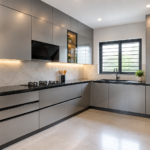
If there is one room where NRI families invest the most, it is the kitchen. Having experienced European modular kitchens and American open-plan cooking spaces, the demand for world-class kitchen design back home is at an all-time high. The modern Kerala kitchen combines German-engineered hardware — soft-close drawers, pull-out pantry systems, island prep stations — with local materials and sensibilities.
Two-tone cabinets are extremely popular: a deep forest green or navy on the lower units paired with crisp off-white or light wood uppers. Quartz countertops with veining that mimics marble are preferred for both aesthetics and Kerala’s humid, high-use kitchen environment. A dedicated wet kitchen — a closed, tiled space for heavy cooking with open flames and grinding — remains an essential companion room, preserving the practical reality of Kerala cooking.
NRI Kitchen Essentials
- Always design both a dry modular kitchen and a separate wet kitchen — this is non-negotiable for Kerala households
- Choose quartz over marble for countertops in Kerala’s humidity — it will not stain or crack
- Install a dedicated chimney vent system rated for high-smoke South Indian cooking
- Plan a large, deep sink — pressure cookers and large vessels are part of everyday cooking
- Include a breakfast counter or island if space allows — it doubles as prep area and casual dining
4. The Master Suite: Luxury as Calm
In an NRI home, the master bedroom is a sanctuary. The design philosophy emerging in Kerala’s top interior projects is one of deliberate luxury — not opulence for its own sake, but the luxury of calm. Beds sit low, with upholstered platform frames in muted linen or leather. Built-in wardrobes run floor to ceiling in matte finishes, keeping the room visually clean. The attached bathroom is a showpiece: walk-in rain showers, freestanding stone-wash basins, and walls clad in large-format terrazzo or textured tiles.
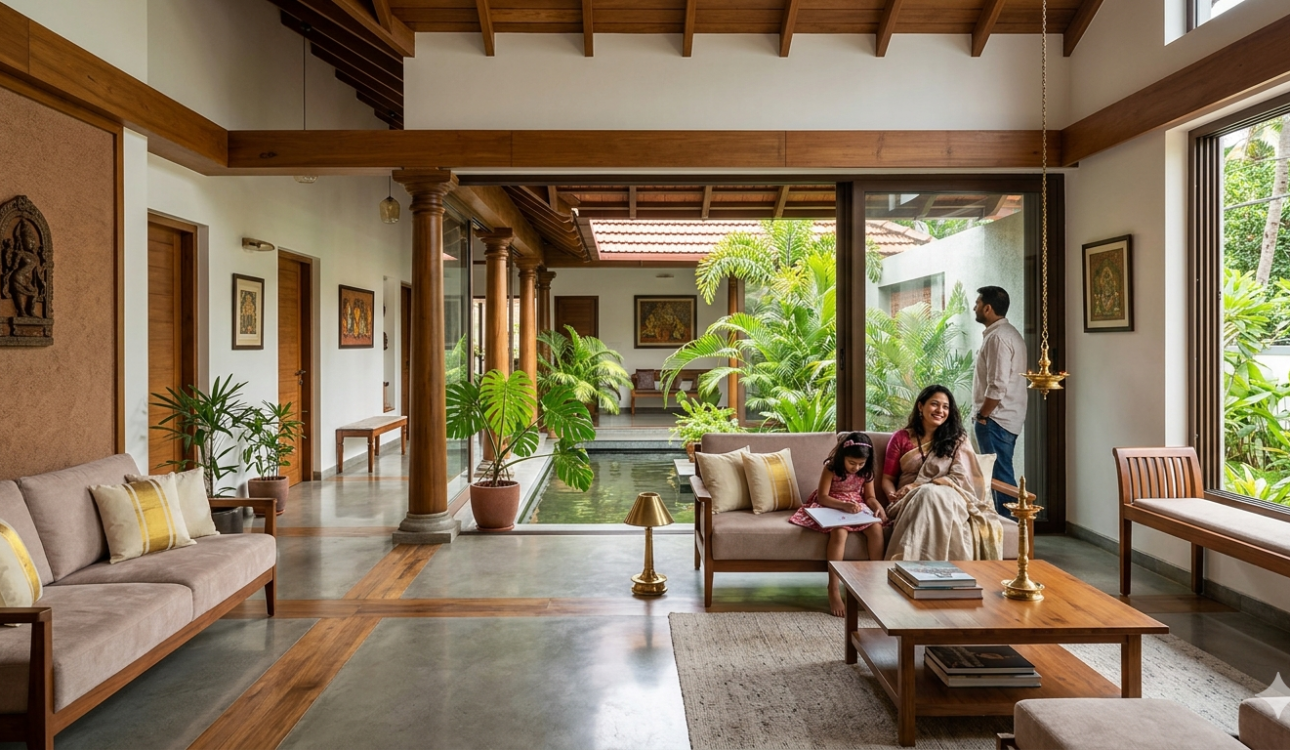
Notably, many NRI families are now reclaiming the traditional nalukettu inner courtyard concept in a modern interpretation — an open-to-sky or glass-roofed central void that brings natural light and rain-sound into the living core of the home, connecting modern structure with ancestral memory.
5. Smart Home Integration
NRI families arriving from tech-forward cities expect seamless smart home systems. In 2025, automation is being built in from the design stage rather than retrofitted. Voice-controlled lighting, automated blinds that respond to sunlight intensity, app-controlled air conditioning, solar panels paired with home battery storage, and video doorbell systems are now standard in this category of homes. Kerala’s improving power infrastructure has made home automation both reliable and affordable at this level.
Smart Home Priorities for Kerala
- Invest in solar + battery backup first — power reliability remains variable in many districts
- Choose a KNX or Zigbee-based smart system for long-term reliability over Wi-Fi dependent alternatives
- Install CCTV and smart locks at gate level — a given for most NRI homeowners who spend time abroad
- Smart water heaters and motorised awnings are high-impact upgrades in Kerala’s rain and heat cycles
6. Outdoor and Landscaping: The Fifth Room
Perhaps the greatest advantage a Kerala home has over a flat in any global city is land — and NRI families are using it beautifully. Landscape design has matured significantly in Kerala, with designers creating outdoor living rooms, lap pools or plunge pools in natural stone, Japanese-inspired dry gardens alongside tropical planting, and covered verandahs fitted as outdoor dining spaces with ceiling fans and soft lighting. The compound wall itself has become a design element — in cut laterite or textured concrete, softened with creeping greenery.
The result is a home that lives as large outdoors as it does inside — extending the usable space of the property and making the most of Kerala’s extraordinary natural backdrop.
“In a world of apartments and high-rises, the Kerala home offers something increasingly rare: the luxury of land, light, and green in abundance.”
Final Thought: Design for Your Real Life, Not Your Imagination
The single most important piece of advice for any NRI family beginning a home project in Kerala: design for how you will actually live, not for an idealised version. Think about joint family needs, visiting relatives, prayer rooms, dedicated home offices for remote work, and storage for goods brought from abroad. A good interior architect will weave all of this into a home that is as functional as it is beautiful — and as deeply Kerala as it is unmistakably global.